Matt Kellner’s missing-person status
The ShardsMatt Kellner’s missing-person status is the point at which an absence that could still be explained as a skipped day or an unannounced trip becomes an official mystery. At Buckley, the school’s restrained announcements and the discovery of Matt’s bloodstained backpack offer fragments rather than answers; at home, his usual routines and the missing red Datsun help define when he vanished. Bret Ellis reads those fragments through the possibility of the Trawler’s pattern, but suspicion never amounts to proof. The status exposes both the limits of the available evidence and the strain of pretending that ordinary school life can continue unchanged.
From Unnoticed Absence to Official Missing Status
For several days, Matt’s absence from Buckley did not immediately alarm his parents. He sometimes went to the beach alone on weekends, and not seeing him on Saturday or Sunday was not unusual. His parents also did not initially check the separate garage where he kept his car. The change came on Wednesday, when a call from Dr. Croft’s secretary asking when Matt would return to school prompted Ronald Kellner to notice the red Datsun was missing; Sheila Kellner realized that the pool house had been dark and the pool unused over the weekend. The Kellners began cooperating with the Los Angeles Police Department once it became clear that Matt had not been seen for at least three or four days, perhaps six.
The timeline was pieced together from small departures from routine. Matt ordinarily swam before school, drove his Datsun to Buckley, and returned to the pool house by late afternoon. On the Thursday before he disappeared, his father had taken the car to a Nissan dealership in Encino to replace a headlight and have it serviced. Matt was confirmed at school the next day: the head of security remembered seeing him leave the school gates alone at about 3:15 p.m. The housekeeper saw him return to Haskell Avenue that afternoon. After that, no one saw him. Unlike his occasional solo trips, this time Matt left no note saying where he was going or when he would return.
Susan Reynolds brought the news to the center table beneath the Pavilion after meeting with Dr. Croft and Headmaster Walters. She described Matt as officially missing, a qualification Bret found less reassuring than simply saying he was missing. The school planned to announce the case at the next mid-morning assembly. As Susan sat with Bret and their friends, the students understood that Matt had not appeared at Buckley for two days and that the red Datsun was not in its usual senior-parking space. Bret dropped his sandwich and struggled to keep his alarm from showing, while the others looked to Susan for an explanation she could not yet provide.
Routine, Evidence, and the Unanswered Journey
Matt’s established habits made the absence legible, but they did not explain it. He usually left a note when he drove down the coast alone, and his pool house often showed signs of his evening routine: aquarium light, candles, or activity around the pool. Over the weekend in question, Sheila noticed no aquarium glow, candles, or sounds, and the Jacuzzi had not been used. Those details helped narrow the period of his absence, although his parents acknowledged that they could not be certain what was typical for their only child.
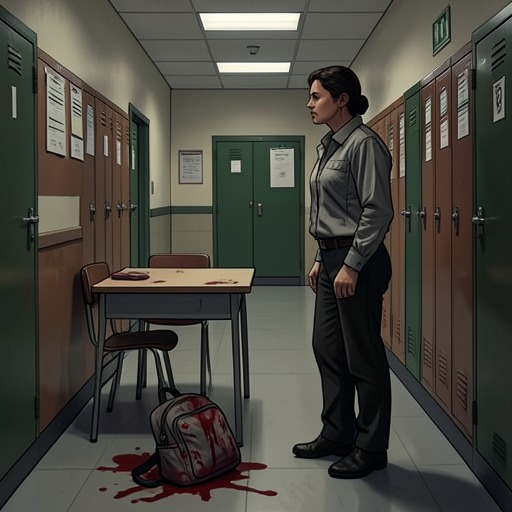
A ranger later found Matt’s backpack in a parking lot at Crystal Cove State Park, above a bluff overlooking the ocean. Its small identification tag connected it to Matt, and blood on the bag brought it to the attention of the Orange County Police, who could match the name to the missing-person report filed with the Los Angeles Police Department. Dr. Croft warned that the information was too upsetting to share broadly at school, particularly with younger students. At Friday’s assembly, Susan therefore repeated only that Matt remained missing and asked anyone with information to contact the administration, promising confidentiality.
The backpack intensified concern without resolving the central questions. The group wondered why Matt had been at Crystal Cove, whether he had been injured, how much blood was on the bag, what it contained, whether anyone had been with him, and where the Datsun was. Susan had no answers. Bret noticed that Robert Mallory and Ryan Vaughn asked none of these questions, while the conversation among the others soon ebbed. Classes continued, students went to physical education at Gilley Field, and Bret later had lunch with Susan, Thom Wright, and Debbie Schaffer without Matt’s name coming up. The case was serious enough to prompt an assembly, yet ordinary schedules and social rituals quickly resumed.
Bret’s Pattern-Making and Its Limits
Bret experienced the announcement differently from the people around him. Matt’s disappearance seemed to him not random but preceded by a sequence of disturbances: anonymous silent calls, rearranged furniture, missing aquarium fish, and a missing cat. These signs echoed the animal disappearances associated with the Trawler’s earlier home invasions, in which pets belonging to a target or neighbors vanished before attacks. But Matt was male, and Bret knew that the Trawler’s crimes had involved both men and women. He could neither dismiss the apparent pattern nor treat it as conclusive. His fear moved between the possibility that Matt had become another victim and the possibility that he had simply left town without telling anyone.
Bret’s private knowledge made the uncertainty harder to bear. He believed that few people knew about the disturbances at Matt’s home, and he feared that explaining his concern would expose the intimate nature of their relationship. He also tried to preserve several other parts of his life at once: his public relationship with Debbie, his secret relationship with Ryan, his place at school, and his effort to watch Robert from what he called a neutral perspective. The missing-person announcement thus created a second, personal crisis: Bret feared for Matt but felt unable to show how much he knew or why the disappearance mattered to him.
Ronald Kellner’s account of the Datsun’s mileage challenged the idea that Matt had driven to the coast himself. Ronald had noted the mileage when he took the car to the dealership on Thursday and checked it again a week later when the car was back in the guesthouse garage. He concluded that Matt had not driven the roughly 140 miles to and from Laguna Beach. This did not establish what had happened, but it contradicted the easy possibility that Matt had made a routine coastal trip in the car. The detail made the vehicle a measure against which a reassuring explanation could be tested.
Suspicion, Disclosure, and the Continuing Mystery
The disappearance also fed Bret’s growing suspicion of Robert. Earlier, Robert had told Bret that Matt, Susan, and Thom had called him a liar; after Matt vanished, Bret began connecting the absence with the Trawler’s crimes and with the periods when Robert had been in Los Angeles. When Bret later pressed Abigail Mallory about a timeline linking Robert’s presence to victims’ disappearances, she rejected the accusation and insisted that Robert had been panicked after someone from Buckley saw him at a movie with Katherine Latchford. Dr. Croft likewise called Bret’s proposed timeline an enormous leap. These exchanges frame the distinction between a clue that invites inference and evidence that demonstrates responsibility.
The school’s response remained measured: Matt was still missing, information was requested, and the bloodstained backpack was not disclosed to the wider student body. For Bret, however, every withheld fact and every ordinary scene acquired weight. He feared that the backpack was a prelude to news of a death, even as the school continued its classes and lunches. The account preserves that unresolved interval between disappearance and explanation. Matt’s status is officially confirmed, the search has identifiable leads, and the signs around him appear ominous; none of those facts, by itself, settles who was responsible or what happened to him.